In AI, the subject of context management is a hot topic again and for good reason.
This recent research paper dives into Titans + MIRAS. An architecture + framework that aims to let models injest more and more raw context, through a variety of techniques like inference-time parameter updates, smarter “surprise” signals, and more.
It’s impressive work, and as compute costs come down, it’ll matter more and more, but when you operate in specific environments like engineering, and especially inside real codebases, the challenge is not “more context.” – It’s “right context.” and within those parameters, domain specific context engine wil outperform brute force long context models.
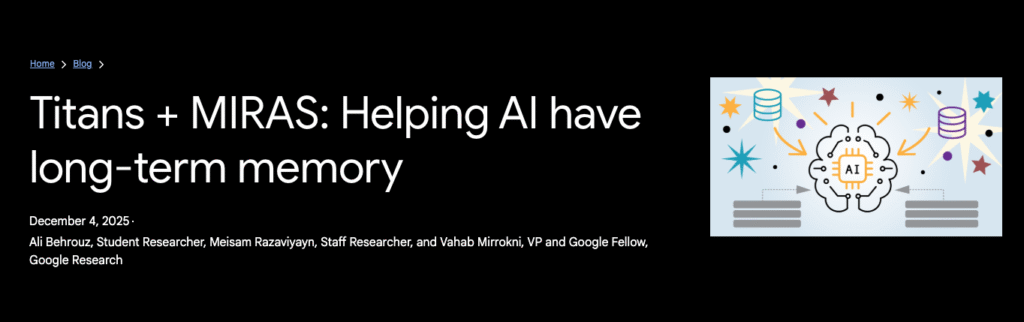
TL;dr: What the Titans + MIRAS research actually does
Before we dive into how’s and whys, here’s a brief introduction on what Titans + MIRAS is.
Titans introduces a neural long term memory module that works alongside short term attention. Instead of relying on a single fixed hidden state, the model uses a deep MLP to store and update long term information. Memory is updated during inference using a surprise signal that decides what is worth retaining.
MIRAS generalizes this idea into a broader framework, describing how different sequence models choose their memory structure, attention objective, retention mechanism, and update rule.
The result is an architecture that can recall information across extremely long sequences while keeping inference efficient.
The broader field: other recent long context efforts
While possibly a very advanced version, Titans+MIRAS are not alone in their space, they are part of a broader push to extend context handling across long sequences.
Models like Gated DeltaNet, MemMamba, and other state space and recurrent hybrids explore variations of structured memory, gated updates, and decay control to improve long range recall.
In the end, they all share a common theme: The attempt to find new ways to preserve important information without relying solely on attention or brute force scaling.
Why engineering contexts require a different mindset
It’s simple. Most long context work treats the world as a stream of tokens, and that works for natural language, genomics, documents, logs, numbers and time series.
But software engineering is different.
Codebases are structured systems with functions, modules, dependencies, build graphs, configuration surfaces, test behavior, side effects, environment state, and abstractions teams rely on.
Treating all of this as a single sequence and asking a model to remember everything doesn’t work very well and leads to several problems: loss of structure, unnecessary memorization, brittle reasoning, and cost that scales with token count rather than relevance.
It’s a bold claim, but it is possible to say that In engineering, long context is not a memory capacity problem. It is a precision and structure alignment problem. And while the economy of AI is based on token usage, the base model providers will always be under-incentivized to solve it.
That is the reason we built ACE.
Why ACE is the right tool for engineering and how it layers with Titans
ACE does not expand model memory. It reshapes the context problem.
ACE turns codebases into deterministic, queryable, semantically rich representations: semantic graphs, dependency maps, architecture rules, configuration surfaces, and behavioral metadata.
ACE surfaces exactly the information required for the task. The model does not memorize millions of tokens. It receives the structural facts that matter.
ACE and memory oriented architectures like Titans or MIRAS are complementary layers. ACE provides structure and constraints. Long memory models provide capacity and abstraction. Combined, they create a system that can operate reliably inside real engineering environments.
What this means for real world AI engineering
- For code grounded tasks, context engines like ACE reduce noise and increase determinism.
- For tasks involving large documents or logs, memory oriented models matter, but only when paired with structured context that filters for relevance.
- For organizations planning long term AI adoption, the pattern is clear: model architecture plus domain specific context engine is the path to reliable performance.
Conclusion
Titans and MIRAS represent progress for long context AI. But in engineering, where systems are structured and evolve constantly, the bottleneck is not raw memory. It is structured context.
It’s best to view these two as layers that can be stacked one upon the other.
With Titan-class architectures pushing the frontier of what a general model can absorb and ACE-class systems making that power practical by reducing the context to what matters inside a specific domain.
As one scales model capacity, the other scales the problem down to something solvable and usable
As long-context models get cheaper, they’ll plug into ACE-style engines seamlessly. But the engines will still do the heavy lifting of structuring context, enforcing constraints, and keeping models grounded in how software actually behaves.
ACE does not replace long memory models. It enables them.
As memory oriented architectures improve and become more affordable, ACE style engines will unlock their potential by ensuring models do not just remember more, but remember what matters.
General-purpose upgrades expand capability. Domain-specific context engines convert that capability into reliability.
That combination is where real value will come from.