The bottleneck was never writing the code. It’s the queue every change has to funnel through.
AI made generating code roughly ten times faster. Shipping barely moved. That gap is the whole story, and it’s costing you more than you think.
The math that doesn’t add up
A PM can spec a feature in an afternoon. A designer can mock it in a morning. Then the idea joins a line. It waits behind the current sprint, the incident that ate Tuesday, the migration nobody wanted, and the roadmap items that outrank it. A change that took hours to define takes a quarter to reach users.
Everyone points at engineering capacity. That’s the wrong target. Your engineers aren’t slow. They’re the only path a change can take, so every idea from every team on every quarter routes through the same finite group of people. The queue is the bottleneck. Making code generation faster just grows the pile of specs waiting at the same door.
The first two waves missed this
Wave 1 was building new apps from a prompt. Great for prototypes and greenfield, useless against your real production codebase. Wave 2 made engineers faster: autocomplete, chat, agents in the IDE. Real gains, and the queue stayed exactly where it was, because the same people were still the only ones who could push a change through.
Wave 3 moves the starting line. The author of the idea authors the change. The PM who wrote the spec produces the code. The designer who drew the screen produces the screen. Engineering stops being the only road in.
How Fei Studio actually does it
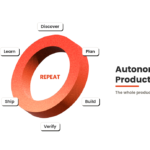
A PM or designer describes the change in plain language. Fei works inside your real codebase, on your actual components and conventions. It builds the change, renders it, and visually verifies its own work against the running product. Then it opens a production-ready pull request. An engineer reviews that PR and merges it.
Engineering moves from writing every change to approving the ones that matter. The small, well-specified, clearly-correct changes come in already built and already checked. Your engineers spend their attention on architecture and the hard calls, which is where you wanted it in the first place.
What this looks like on a Tuesday
A PM types “make the Upgrade button orange everywhere.” Fei finds every instance across the codebase, changes each one, renders the result, and confirms visually that the button is orange where it should be and nothing else broke. It opens a PR. An engineer glances at a clean, validated diff and merges it. The change ships the same week it was specced, not the quarter after.
This isn’t a demo story. Our own PM has authored more than 50 pull requests to our production codebase without writing a line of code. Around 70 percent of them merged. Every single one was approved by an engineer.
“But an engineer still reviews every PR”
Correct, and that’s the point. The gate stays exactly where it is. Nothing reaches production without an engineer’s approval. What changes is the job on the other side of that gate. Authoring a change used to take days of an engineer’s time. Approving a validated PR that already renders correctly takes minutes. The control stays with engineering. The hours don’t.
That’s the difference between a bottleneck and a checkpoint. A bottleneck holds everything up. A checkpoint waves through what’s already right and stops what isn’t.
The bottom line
You already have the ideas. You have people who know exactly what to build and can describe it precisely. The only thing standing between a good spec and a shipped feature has been access to the codebase. Fei Studio gives your product and design teams that access, with engineering keeping the final say on everything that merges.
The people who know what to build, finally ship it.
Want to see it on your own codebase? Book 20 minutes and we’ll go deeper.