Ask a product leader what slows them down and you’ll hear about handoffs. Ask an engineering leader and you’ll hear about review. We spent two months listening to both, and it turns out they’re describing the same problem from opposite ends.
Between August and September we read every external call our team had with product and engineering leaders: 326 calls, of which 237 were conversations with buyers at 131 B2B software companies. We logged 1,103 separate complaints about how work gets done today, tagged each one by theme, and counted by company so a customer we spoke to fifteen times counted once. Most of what people raised came up before anyone mentioned a product.
The report is out today. Here is what it says, in short.
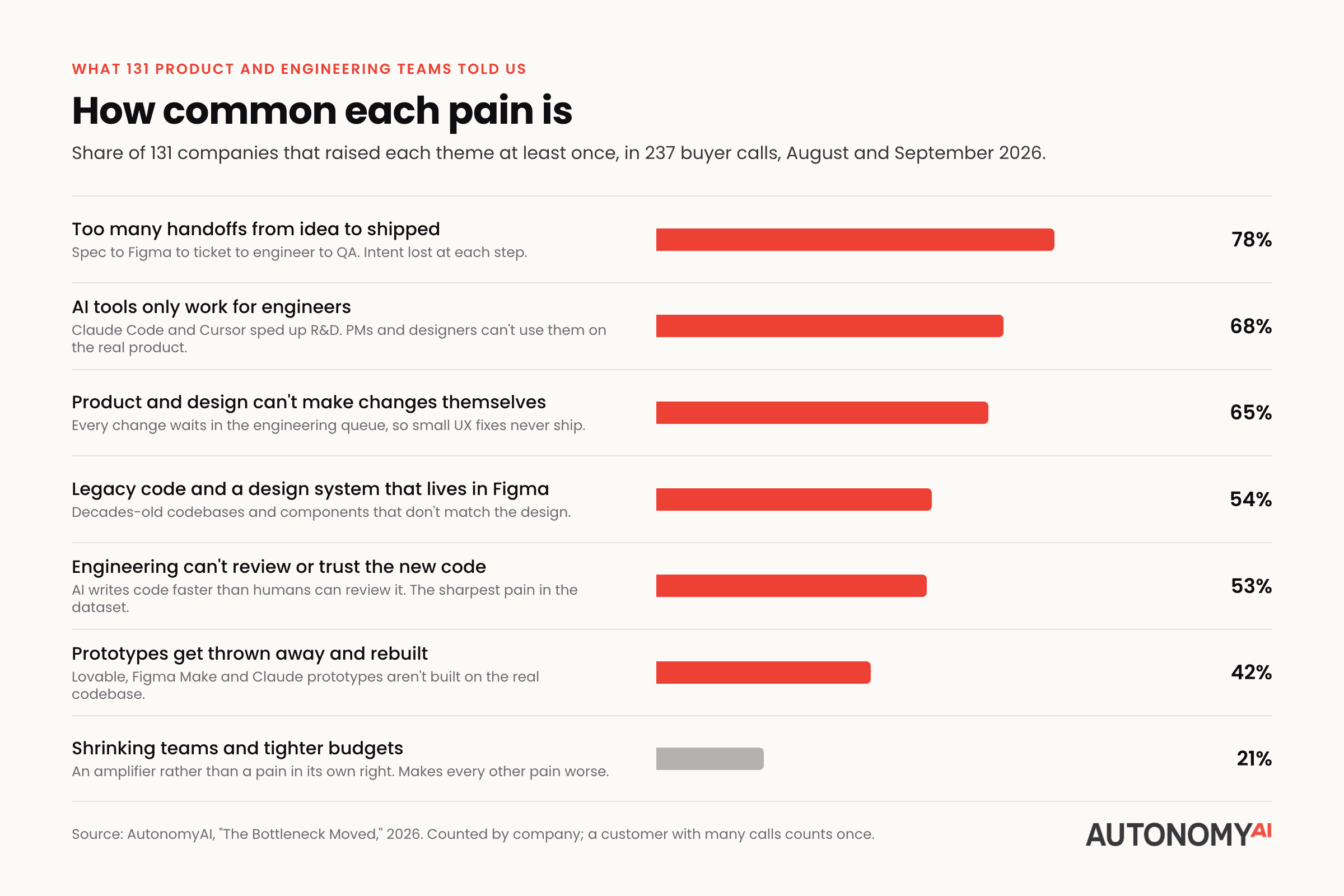
The six pains, ranked
Share of the 131 companies that raised each theme at least once.
Three things stand out.
The pains travel together. Four out of five companies raised three or more of them. Handoffs, tooling and being locked out of the product are almost always raised by the same company, which is why the report reads them as one chain rather than a list.
Product and engineering raise different links. Product is the loudest voice on handoffs, tooling, being locked out and prototypes. Engineering is the loudest voice on legacy code and trust. Product can’t get changes in. Engineering can’t safely let them through.
Trust is where it hurts most. The trust theme ranks fifth by how many companies raise it and first by how sharp it is. Of the 70 companies that raised it, 30 called it an acute problem, 43%. No other theme comes close.
AI made code cheap. Shipping didn’t get faster.
Every company we spoke to has an AI mandate, and engineering got the tools. Claude Code, Cursor and Codex are standard in R&D. Engineers write more code than ever, and leadership now expects the whole product organization to move at that speed.
The rest of the chain didn’t change. An idea still travels from a PRD to Figma to a ticket to an engineer to QA, and it loses a little of what the person meant at every step. Buyers describe the result in calendar time: weeks for a simple change, quarters for a feature, a year for an idea from the field.
So product teams tried the workarounds. They picked up the developer tools and hit terminals, local environments and Git. They built prototypes in Lovable, Bolt and Figma Make and watched engineering rebuild them from scratch, because none of them were built on the real codebase.
And then the part most leaders haven’t caught up with yet: engineering can no longer review or trust the volume of code arriving. That’s where the bottleneck moved.
In their words
The numbers tell you how common each pain is. The calls tell you what it feels like.
A Head of Design at a sales software company, on the small work that never ships:
To engineering they’re all low-level items, not critical, so they always end up at the bottom. For me, they’re the number one thing.
A product architect at an observability company, on where the queue now forms:
The maintainer team is overwhelmed and flooded with pull requests. Suddenly the bottleneck is verification and review, and no longer producing the code.
Both of them use AI heavily. Neither of them is short of code.
What it means
For twenty years the scarce resource in software was engineering time to write code. In these companies, code is no longer scarce. What’s scarce is the ability to turn an idea into a change that engineering will accept into production. Three things follow.
The unit of progress is a merged change. Buyers don’t measure AI by lines produced. They measure it by what reached production without a rewrite. A tool that generates more unreviewable output makes the trust problem worse, whoever is holding it.
Whatever lets product and design ship has to live inside the real codebase. Every workaround that sits beside the product ends in a translation step. The design system, the components and the conventions are in the repository, and that’s where the work has to happen.
Trust is the design constraint. Engineering and security won’t lower their gates, and they’re right to hold them. A change from a non-engineer has to arrive small, verified, and inside the review process and security boundary that already exist.
What to do about it
The report closes with five recommendations, and none of them requires buying anything. The two we’d start with:
Write down the operating model before adding more tools. Who may open a pull request, who reviews it, what a change from a non-engineer has to prove, where the security boundary sits. The most-raised gap inside the tooling pain was a mandate with no method.
Measure merged changes from outside engineering. Count how many reached production last quarter. For most companies in this report the answer is close to zero, and that number, rather than lines of code generated, is the one to move.
The other three, the methodology, the full data tables and all ten pages are in the report.
AutonomyAI builds Autonomous Product Delivery for product and design teams. The calls this report is based on were ours, and the report says so on page 4.