A software factory for product teams is a system of AI agents that turns a change described by a product manager or designer into a pull request on the company’s real codebase. Product decides what gets built. Engineers approve every merge.
Here’s the smallest example. A product manager types “make the Upgrade button orange everywhere.” The system finds every instance in the codebase, makes the change, checks it in the running app, and opens a pull request. An engineer approves it. Nobody filed a ticket, and nothing waited for a sprint.
More than 170 product teams run on AutonomyAI today. This post covers why product teams need a factory of their own, what makes something a factory, and what to ask before you buy one.
Engineering has a factory. Product is still at the front desk.
Nearly every engineering org has adopted AI coding agents, and the ambitious ones have built whole systems around them on their own codebase. Engineers have never produced code faster. That setup is what people now call a software factory.
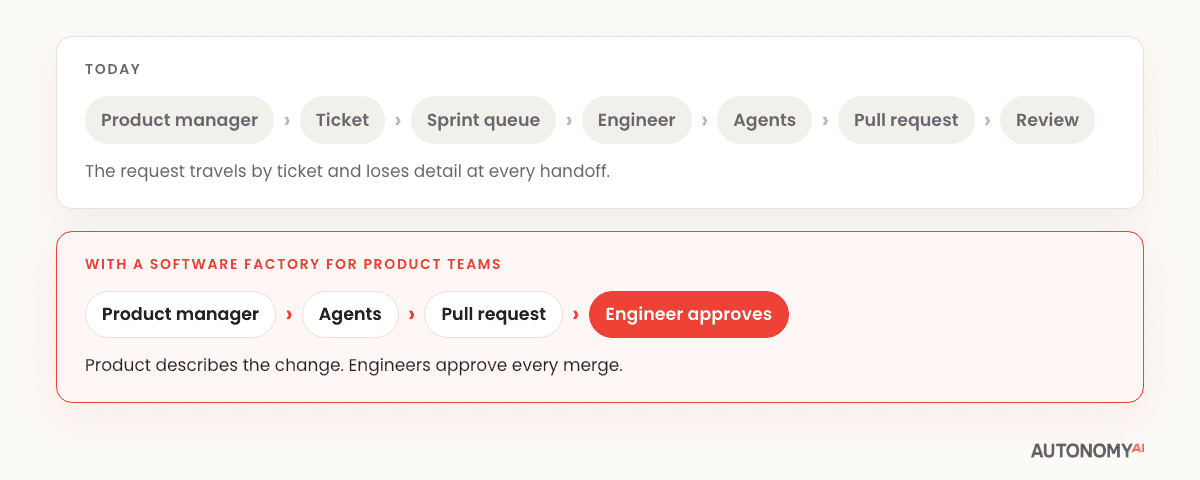
Look at who the factory takes orders from. A product manager who wants a change still writes a ticket. The ticket waits for a sprint. An engineer picks it up, asks what was meant, and feeds it to the agents. The factory floor got fast, and the front desk works the way it always did.
That matters because a factory builds what it’s told. The people who know what to tell it are on the product side. They know which customer is stuck, which screen confuses people, and which fix sales keeps asking for. Today that knowledge reaches the factory by ticket, and it loses detail at every handoff.
What changes when product gets its own
A software factory for product teams gives product managers and designers a direct line in. In AutonomyAI Studio, the one we build, it works like a small team of specialists:
- A researcher reads your analytics, support tickets and customer calls to find what’s worth fixing.
- A planner turns that into a spec that fits your existing architecture.
- A builder writes the change with your components, your design system and your engineering conventions.
- A verifier boots your actual app, checks the result in the real UI, and prepares the pull request.
Product people step in for the judgment calls. Then the pull request lands in the same review queue your engineers already use, and nothing merges without their approval. We call the whole loop Autonomous Product Delivery.
What makes it a factory
Four things separate a factory from a coding tool with a friendly interface.
It runs on your real codebase. The output is a change to the product your customers use today, written the way your team writes code. A new app in a sandbox that someone has to rebuild later doesn’t count.
It checks its own work. A factory has quality control on the line. Here that means the system runs your app, looks at the result, and fixes what’s off before an engineer sees it.
It covers the whole line. Finding what to build, writing the spec, building it, checking it and handing it to review all happen in one system, so nobody re-explains the request at each step.
It gets better with use. Every merged pull request teaches the system more about how your codebase works and what your reviewers expect.
Where the term comes from, and where the people went
Hitachi was the first company to use the term, in 1969, for its Hitachi Software Works. The idea was the one behind any factory: software should come out of a repeatable process with quality checks built in, whoever happens to be at the keyboard.
In 2026 the term came back, because AI agents can now do most of the building. StrongDM published a widely cited version in February 2026. It runs on two rules: humans don’t write the code, and humans don’t review it. By September 2026, Gartner was publishing research on AI software factories.
A software factory for product teams makes a different choice about people. It keeps two groups on the line, on purpose. Product owns the decisions: what to build, for whom, and whether the result is right. Engineering owns the merge: every change goes through pull request review, by the same people, under the same rules as any other code.
That split is what makes it safe to adopt. Work that used to arrive as tickets arrives as pull requests, and engineers keep full control of what reaches production.
Five questions to ask before you buy one
- Who operates it day to day: a product manager, or an engineer on their behalf?
- Does it work on our existing production codebase?
- Does it run our app and check the change before it asks for review?
- Does every change go through our normal pull request review?
- Does it learn our components and conventions on its own, or do we configure them by hand?
If the answer to the first one is “an engineer,” it’s an engineering factory, and product still goes through the front desk. For a side-by-side of the tools product teams ask us about most, see how AutonomyAI Studio compares.
Common questions
No. A dark factory, named after plants that run with the lights off, aims to take people out of the loop entirely. A software factory for product teams keeps product and engineering in it.
No. It moves them from the start of the process to the end. They used to receive a ticket and build from scratch. Now they receive a pull request and decide whether it merges.
Yes, and that’s the point of it. The system learns your components, design tokens, architecture and pull request conventions, then produces changes that fit.
A coding tool speeds up writing code. The slow part of shipping is everything around that: deciding what to build, writing the spec, checking the result, getting it reviewed. A factory carries the work through all of those steps.
See one run
Book a demo and bring one change your team has been waiting on. We’ll show you how it goes from a sentence to a pull request your engineers can review.