Ask a CEO what they want from the product organization and the answer has three parts. Hit the roadmap. Work down the backlog. React fast when the market moves.
Most companies bet on AI coding tools to move those three numbers. Code has never been cheaper to produce, and the numbers barely moved. Roadmaps still slip. Backlogs still grow. The answer to a competitor’s launch is still a quarter away.
The tools work. They speed up one seat in a process with six. Atlassian found developers spend 16 percent of their time coding; deciding what to build, specifying it, verifying it and reviewing it still runs at the old speed, through the old handoffs.
Autonomous Product Delivery is built to move the three numbers.
The roadmap holds
Roadmaps slip because everything costs an engineer. The quarter is planned against engineering capacity, then the quarter happens: a bug that matters, a field sales needs, a copy error that has to go today. Each one is paid for out of the capacity that was supposed to deliver the roadmap.
With Autonomous Product Delivery, most of that unplanned work never enters the engineering queue. The product manager who spotted it takes it through research, spec and build on the real codebase, and what reaches the engineer is a pull request to review, in the team’s own conventions, verified against the running product. Review takes minutes. Building would have taken days. The roadmap stops being the thing that gets eaten.
The backlog shrinks
Every backlog has the same list of things everyone agrees matter and nobody schedules: the pricing card with last quarter’s numbers, the empty first-run screen, the ticket that’s worth doing and never worth doing first.
The reason is economic. When every task costs the same scarce unit, an engineer’s attention, planning can only fund work big enough to justify the context switch. Small, high-impact work loses to big, high-impact work every sprint. The cause is cost, and for a decade teams have treated it as a prioritization decision.
Change the cost and the backlog changes shape. The product team works the list down themselves, and items that used to sit a quarter show up as pull requests the same week. Watch the median age of open items in the quarter after the loop goes in. That number falling is the whole story.
Reaction time drops from a quarter to a week
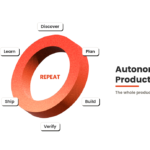
A competitor ships on Tuesday. Today the response waits for a planning cycle, a sprint and an engineer, and lands a quarter later. With the loop, the PM asks the question on Tuesday. Discover Mode researches it across analytics, support tickets, customer calls and the codebase. Plan Mode turns the brief into a spec. Build Mode writes the change, verifies it in the running product and opens a pull request. Engineers review. If it merges, the response is in production the same week.
Discover Mode also watches the product on its own and arrives with the next improvement already scoped. Knowing sooner what to react to is half the speed.
The number that tells you it’s working
Merge rate: the share of product-team pull requests that engineers approve on their own standards. It’s the most honest number in the building, because the people who guard the codebase are the ones producing it. A high rate means trust is earned and the team hands over more. A drop means you’ve found today’s edge of what to delegate. Either way you’re measuring instead of debating. And every merge teaches the Product Harness more about the codebase, so the rate improves the longer you run it.
How to see it in your own numbers
Pick three figures and watch them for a quarter after the loop goes in.
- Roadmap delivery. The share of the quarterly plan that shipped on the quarter.
- Backlog age. The median age of open items. Watch the long tail.
- Question to production. Days from a product question being asked to the change being merged. Time five real ones.
Merge rate tells you whether the first three are safe to trust.
More than 170 product teams run on AutonomyAI today. The roadmap holds. The backlog shrinks. The features that matter ship.
Book a demo with a real question about your product and we’ll run one turn of the loop on your codebase. Or start with the FAQ.