
AI writes code fast. Engineers can’t review it fast enough, so the code sits and waits.
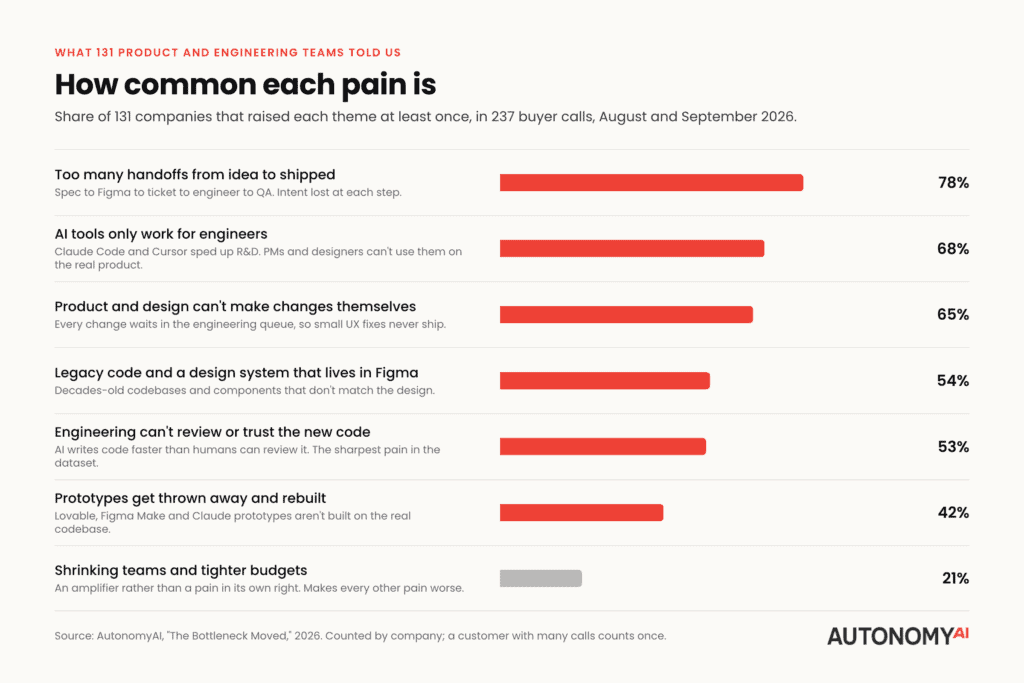
Last week we published The Bottleneck Moved, a report built from 237 calls with product and engineering leaders at 131 B2B software companies. We tagged 1,103 pains by theme and counted them by company, so a team we spoke to fifteen times counted once.
Six pains came out of it. One of them behaves differently from the rest.
Fifth by count, first by pain
Seventy of the 131 companies told us engineering can’t review or trust the code arriving. That’s 53%, which puts it fifth of the six pains by how often it came up.
Then we looked at how sharp each pain was. Thirty of those 70 companies described it as acute: 43%. The next-highest theme, handoffs, sits at 30%. Every other pain lands between 17% and 29%.
So the pain that fewer companies raise is the one that hurts most where it shows up. This post is about why.
What engineering told us
Engineering is the loudest voice on this theme, with 41% of the mentions. Their descriptions were consistent. Pull requests pile up. Diffs arrive too large to review properly. When product or design produce code, engineers reject it, rewrite it, or leave it sitting in the queue.
An engineering leader at a travel technology company put the arithmetic plainly:
We’re already too good at writing code. We can write more code than we can possibly read and review.
A Head of Product at a developer tools company described what a reviewer feels when the diff lands:
Imagine a PR with a 5,000-line diff. Every engineer thinks, I would rather build this myself than review it.
A product architect at an observability company named where the queue now forms:
The maintainer team is overwhelmed and flooded with pull requests. Suddenly the bottleneck is verification and review, and no longer producing the code.
The second gate
Engineering review is one gate. Security and compliance hold another. Buyers raised data residency, HIPAA, DORA, the need for isolated environments, and a general worry that people outside engineering will break something in production.
Both gates exist for good reasons. Engineering and security are right to hold them. Any change that reaches production has to pass both, whoever wrote it.
Why it turned acute now
Claude Code, Cursor and Codex are standard in engineering at the companies we spoke to. Engineers write more code than ever, and leadership expects the rest of the product organization to move at the same speed.
Writing code got cheap. Checking it stayed expensive. Review still runs on people who understand the system, and their hours did not grow with the volume arriving. Some of these teams also got smaller over the same period: 21% of the companies described shrinking teams or tighter budgets.
That’s our reading of what buyers told us. The dataset counts what people said; it holds no throughput data. But the pattern in the calls is consistent: the queue moved from the keyboard to the review.
What a reviewable change looks like
The buyers who raised this pain were clear about what they want: changes that arrive verified, small enough to review, inside the guardrails engineering and security already set. Each part of that sentence turns into a practice a team can adopt this quarter.
Keep changes small. Set a diff-size norm for AI-assisted work. A small, verified change gets reviewed. A 5,000-line diff gets rewritten.
Send the evidence with the change. A reviewer should see that the change renders, passes its tests and uses the real components before reading a line of it. Verification that happens before review shortens review.
Keep the existing gates. Changes from anyone, inside or outside engineering, go through the review process and security boundary that already exist. A parallel path is a path engineering will refuse.
Agree what’s in scope. Write down which changes product and design may make: copy, tokens, spacing, layout within existing components. Agree the list with engineering and security before anyone opens anything.
Write the rules first. Decide who may propose a change, who reviews it, and what a change from outside engineering has to prove. In our calls, many of the trust pains came down to rules nobody had written.
Count what reaches production
If review is the constraint, the scoreboard is how many changes reached production without a rewrite.
Count how many changes that started outside engineering reached production last quarter. For most companies in our research, the answer looks close to zero. That’s the number to move, and every practice above moves it.
Trust is the design constraint
AI made code cheap to write. The teams we spoke to are short of code that engineering can trust enough to ship. Any tool, process or team structure that hopes to speed up delivery has to start from that.
The full trust chapter, the other five pains and five recommendations for product and engineering leaders are in the report.