A question we get from engineering leaders: we already have Claude Code, so why not build this ourselves?
Fair question. So we answered it with our own history. We went through every pull request we’ve merged, 6,873 of them, and priced what it would take another team to build Studio to where it is today.
Short answer: 10 to 14 engineers for 15 to 20 months. Then 4 to 7 engineers a year to keep it working.
The estimate
| Engineer-months to reach today’s production maturity | 150 to 280 |
| Team and timeline | 10 to 14 engineers, 15 to 20 months |
| Engineer cost, at $200K to $300K loaded per year | $2.5M to $7.0M |
| LLM tokens to build it, including the agent’s own test runs | $0.8M to $2.5M |
| Engineers to keep it running after launch | 4 to 7 a year |
That’s before QA, product, design, and the sandbox compute for test runs.
The MVP is the easy part
A narrow version is 6 to 9 engineers for 9 to 12 months, roughly $0.9M to $2.7M. It will demo well. That’s the trap.
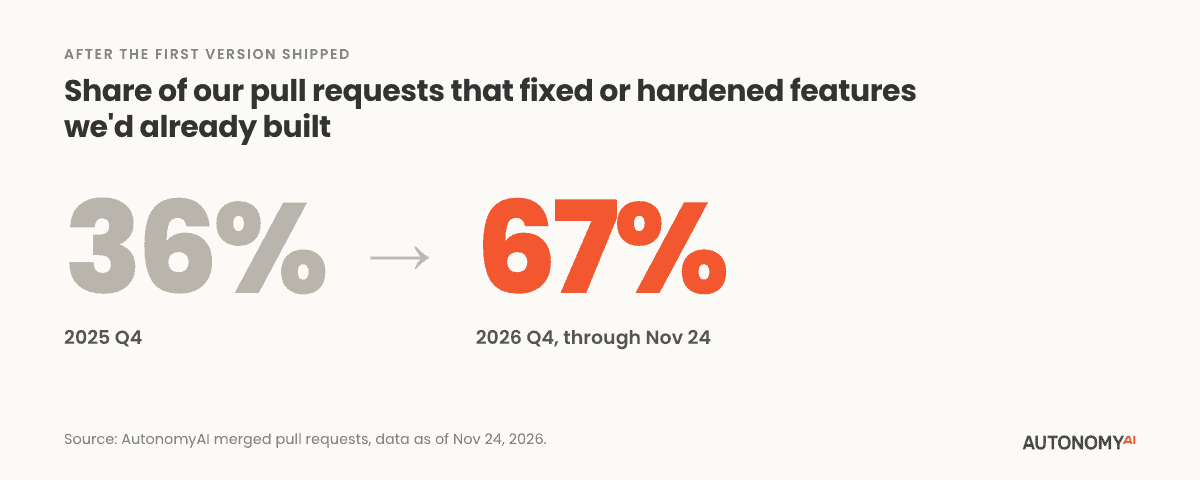
Look at what our own work turned into once the first version shipped. A year ago, 36% of our pull requests fixed or hardened features that already existed. Last quarter it was 67%. Two out of every three changes went into things we’d already built, and that work doesn’t stop after launch.
Where the time goes
We merged 5,406 pull requests while building Studio. A third of them, 1,774, dealt with a hard problem, and the share is going up: 45% in the last 60 days. The big ones:
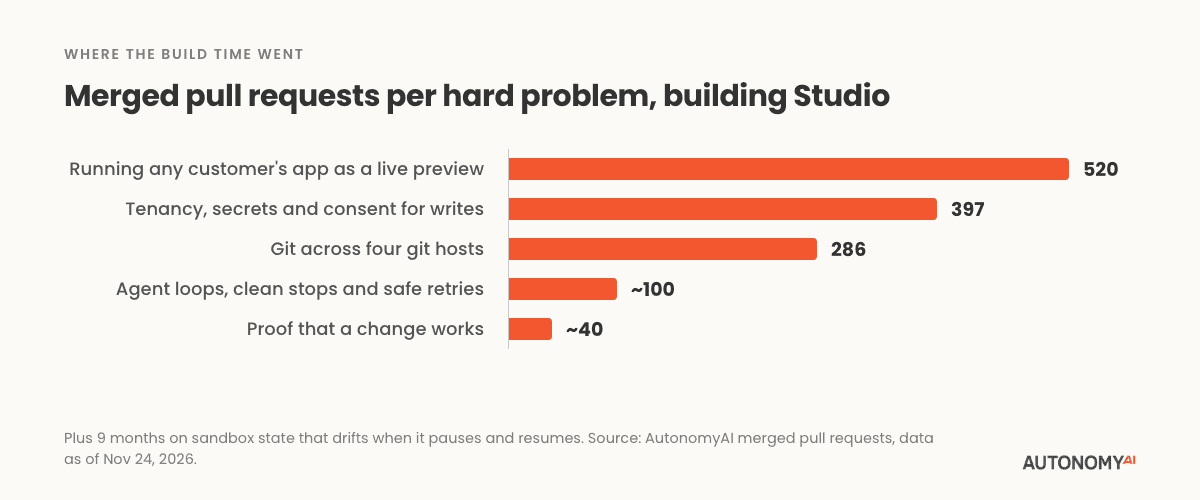
- Running any customer’s app as a live preview. 520 PRs. Every stack boots differently, and nothing else works until the preview does.
- Tenancy, secrets, and consent before writing to anyone’s external tools. 397 PRs.
- Git that behaves the same across four git hosts. 286 PRs.
- Agent loops that can stop cleanly, with retries that are safe to replay. About 100 PRs.
- Proof that a change works, checked in the running app. About 40 PRs.
- Sandbox state that drifts when it pauses and resumes. 9 months to get right.
None of these show up in a demo. All of them show up in the first week with a real customer codebase.
What makes the run cost explode
Building it is one bill. Running it is another, and it gets out of hand fast. A few we hit:
- Missing the prompt cache: about 9x the LLM bill.
- Runaway tool loops: 228 tool calls in 12 minutes.
- Idle sandboxes: kept alive for an hour after the last use.
- Bursts: 728 sandbox creations rejected in a single hour.
Each one is fixable once you’ve found it. Finding it is the expensive part.
How we measured
The estimate is anchored on what Studio cost us to build.
- Our build: 15 months, about 142 engineer-months, 5,406 merged PRs. Production code today is 581K lines, plus 757K lines of tests.
- Start point: those 142 engineer-months, plus 35 to 60 more for agent infrastructure we reused from earlier work.
- Low end: a team copying a known target, skipping some of the discovery and rework we went through.
- High end: a team less agent-native than ours, at 1.5x the effort.
- Tokens: $4K to $8K per engineer-month for coding agents (we measured $34 per merged PR), plus about $15K a month to run the product’s own agent in dev and CI.
- Not included: QA (about one per four engineers), product, design, and sandbox compute for test runs.
When building it yourself makes sense
It can. If you can put 10 or more engineers on it for a year and a half, keep 4 to 7 on it after that, and nothing on your roadmap needs them more, the math works.
The question is what those engineers would build instead.
If you’d rather buy it
Studio is what we built: a software factory for product teams that runs on your real codebase, checks its own work in your running app, and hands your engineers a pull request to approve. More than 170 product teams run on AutonomyAI today. Book a demo and we’ll show you how a change goes from a sentence to a pull request your engineers can review.