
Designers and PMs can see what needs fixing. They just can’t fix it themselves.
You know the list. The button label that says the wrong thing. The spacing that’s a few pixels off. The gray that doesn’t match the one in Figma. Everyone on the product team can see these problems, and only engineering can change them. So they sit in the backlog, sprint after sprint.
Earlier this month we published The Bottleneck Moved, a report built from 237 calls with product and engineering leaders at 131 B2B software companies. This problem came up again and again.
This post covers what those teams told us, why small fixes lose every time, and a simple way to get them shipping.
Nearly 2 in 3 companies raised it
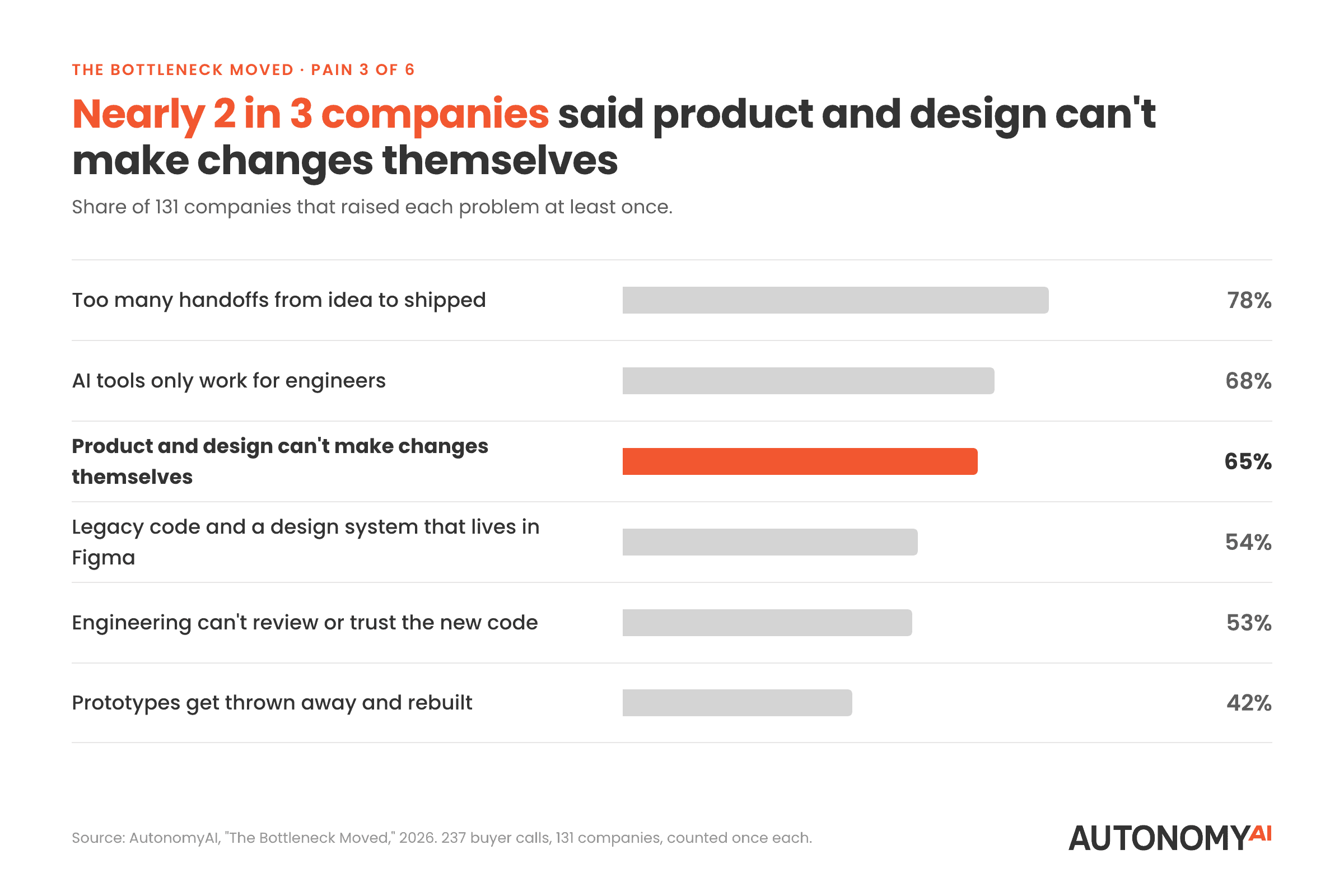
85 of the 131 companies told us product and design can’t make changes to the product themselves. That’s 65%, the third most common of the six problems in the report.
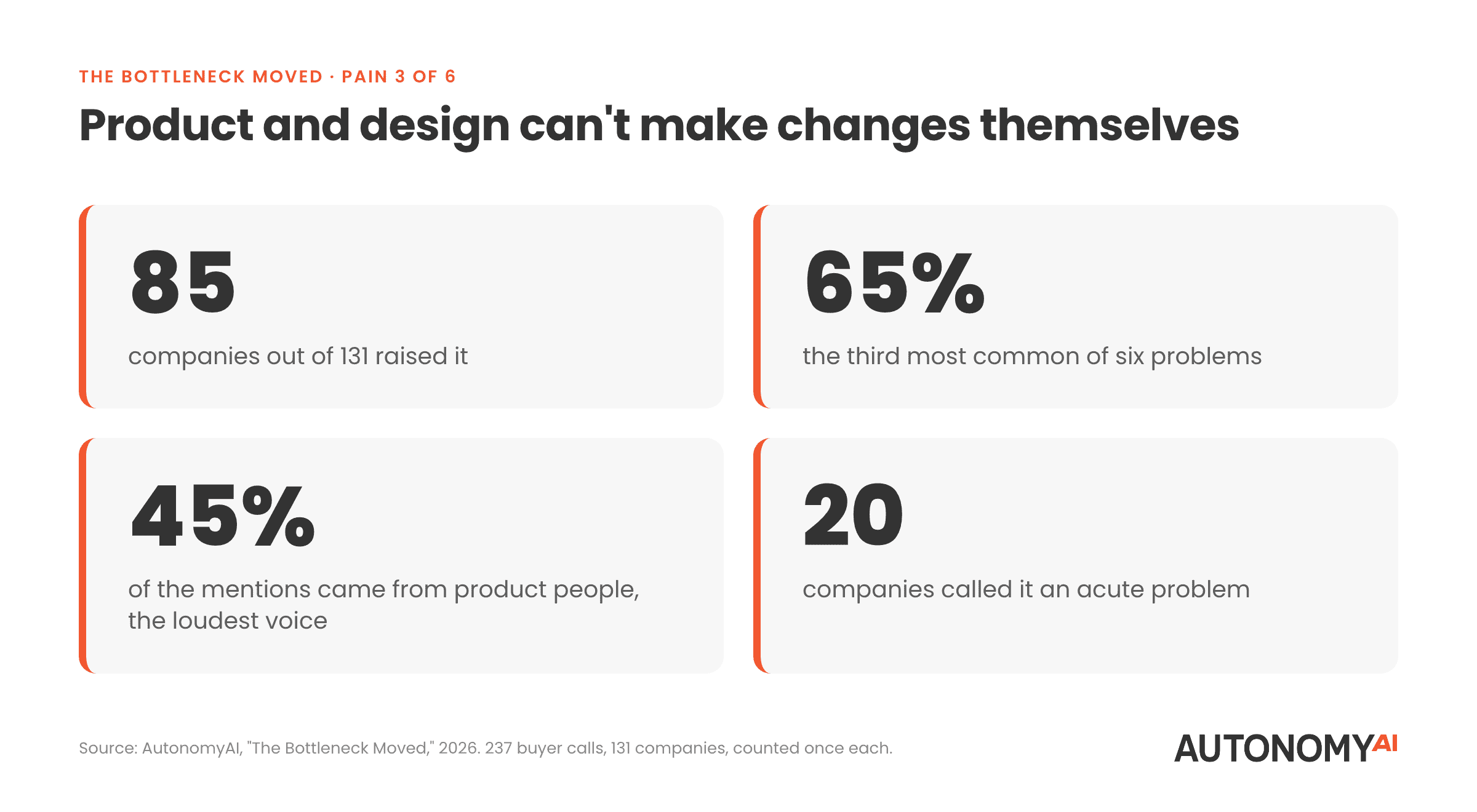
Product people raised it more than anyone else, with 45% of the mentions. And 20 of those 85 companies called it an acute problem.
In their words
A Head of Design at a sales software company:
To engineering they’re all low-level items, not critical, so they always end up at the bottom. For me, they’re the number one thing.
That one sentence is the whole problem. The fix matters most to the person closest to the customer, and least to the team that has to build it.
A UX lead at a consumer intelligence company described how deep the drift goes:
Our color tokens and base icons, the most fundamental parts of every component, aren’t correct in the code.
Even the basics drift. The people who notice have no way to fix them.
What counts as a small fix
Small fixes are the changes that make a product feel finished. Here are common examples:
| Type | Example | Who usually spots it |
|---|---|---|
| Copy | A button label or error message that reads wrong | PM, designer |
| Colors and fonts | A gray that doesn’t match the design system | Designer |
| Spacing | Padding between cards that’s a few pixels off | Designer |
| Layout | A section that should sit higher on the page, built from existing components | PM, designer |
| Polish | An icon that’s misaligned on one screen | Anyone on the team |
Each one takes minutes to change. Each one can wait for months.
Why small fixes lose every time
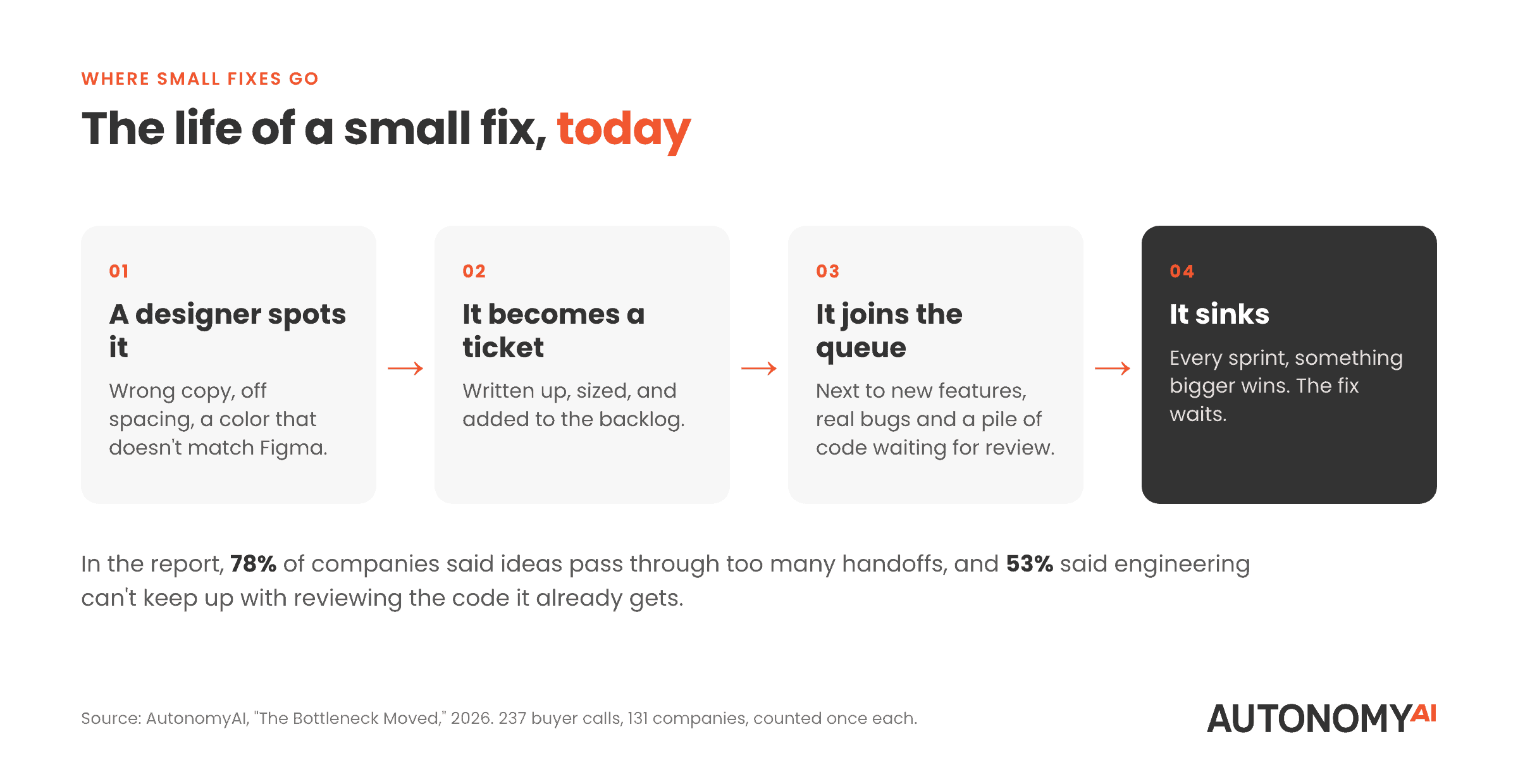
The teams in our report described two problems hiding inside this one.
There’s no approved way in. PMs and designers have no environment to work in, no access, and no path for their changes to reach engineering.
Everything goes through engineering. So small fixes compete with new features and real bugs for the same engineering time, and they lose every priority fight.
Two other findings from the report make it worse:
- Every fix takes the long road. 78% of companies said ideas pass through too many handoffs: spec, Figma, ticket, engineer, QA. A one-line copy change walks the same road as a new feature.
- Engineering is already full. 53% of companies said engineering can’t keep up with reviewing the code it already gets.
The result: the work that matters most to how the product feels is the work least likely to ship.
Small fixes rarely travel alone
This problem shows up with friends. 80% of companies in the report raised three or more of the six problems. Being locked out of the product almost always came up alongside too many handoffs and AI tools that only work for engineers.
That last one matters here. 68% of companies said AI tools only work for engineers. Engineering got coding agents. PMs and designers who try those tools hit terminal setup and Git, then get output that ignores the design system. So the people who spot the small fixes still have no way to make them.
The fix: agree a lane for small work
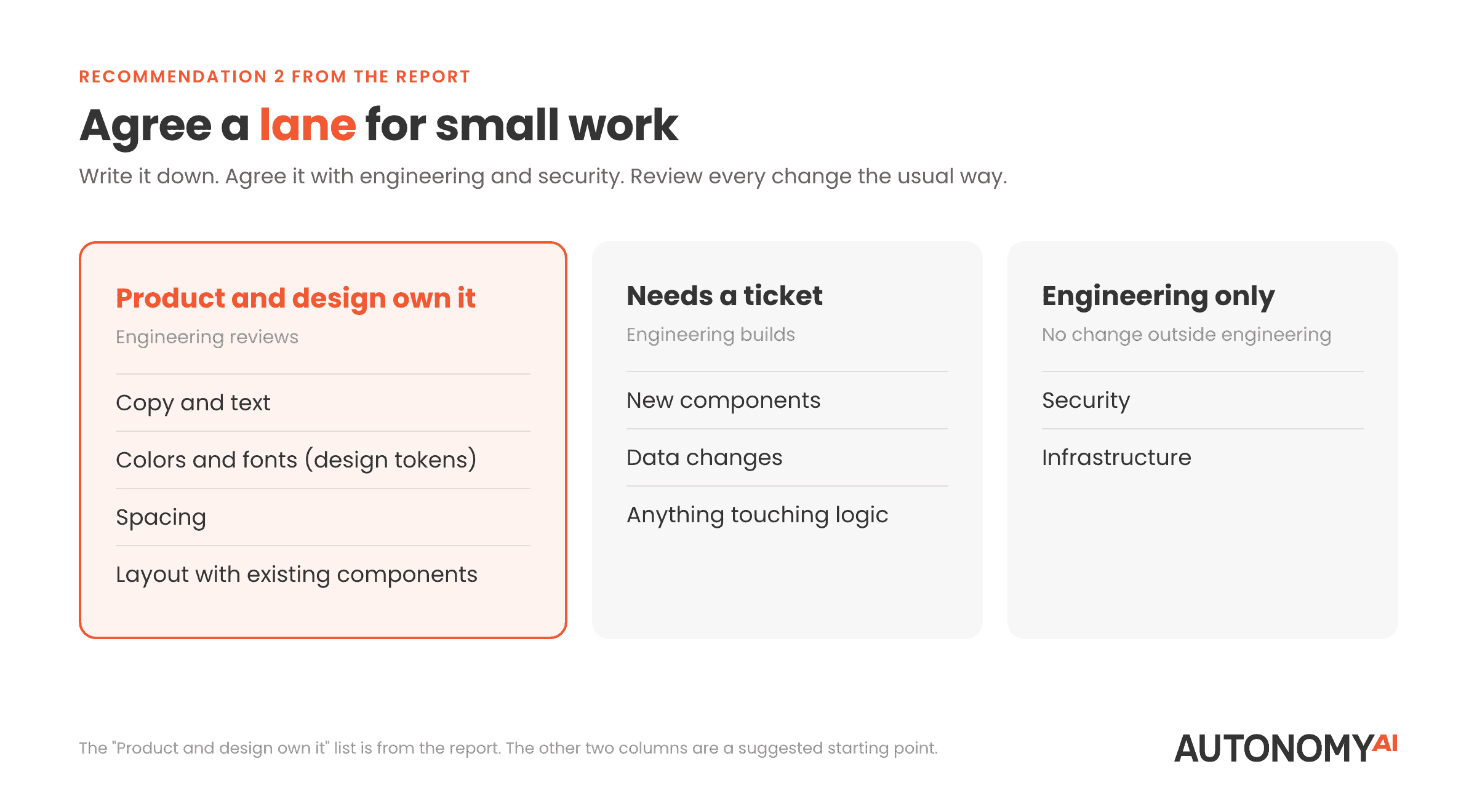
The report’s recommendation is simple: write down which small changes product and design are allowed to make.
A good starting list:
- Copy and text
- Colors and fonts (design tokens)
- Spacing
- Layout, using components that already exist
Agree the list with engineering and security first. The agreed lane is what gets the small fixes shipping. Tools come after.
Today, and with an agreed lane
| Today | With an agreed lane | |
|---|---|---|
| Who makes the change | An engineer, when the ticket comes up | The PM or designer who spotted it |
| Where it waits | In the backlog, behind bigger work | In review, like any other change |
| What engineering does | Writes the change from a ticket | Reviews a small, finished change |
| What users see | The same issue, sprint after sprint | The fix, once engineering approves it |
Three rules for every lane change
The lane only works if engineering is happy to say yes. Three rules help:
- Keep it small. One fix per change. Small changes are fast to review.
- Check it before review. The change should render, use the real components, and match the design system before an engineer opens it.
- Use the same review. Lane changes go through the same review process and security checks as every other change.
Small and checked gets merged. Large and unchecked gets pushed back.
Fix the design system first
54% of companies in the report raised legacy code and a design system that lives in Figma. If the colors and components in the code don’t match Figma, every small change starts out wrong.
So before the lane opens, check the tokens and components in the code against Figma, and fix the gaps.
Where AutonomyAI fits
Small fixes are the kind of work we built Fei Studio for.
Fei Studio is built inside your production codebase. It learns your components, design tokens, architecture and pull request conventions. A PM types “make the Upgrade button orange everywhere.” Fei finds every instance, makes the change, runs the app and checks the result visually, then opens a pull request. An engineer reviews it and approves it, the same way they review any other change.
That fits the lane: small, checked before review, and inside the gates engineering already runs. More than 170 product teams use AutonomyAI today.
Start this quarter
- List the small fixes sitting in your backlog today.
- Agree the lane with engineering and security, in writing.
- Check your design system in code against Figma, and fix the gaps.
- Next quarter, count how many of those fixes reached production.
Buyers told us what they want: a governed way for product and design to ship the changes they own, so engineering time goes to the hard problems. The lane is the first step.
The full report covers all six problems, the data behind them, and five recommendations for product and engineering leaders.